
Please Explain The Surge.
Pauline Hanson's One Nation has had recent success in the polls and in South Australia, but neither presage a nation-changing, and lasting, far-right surge.

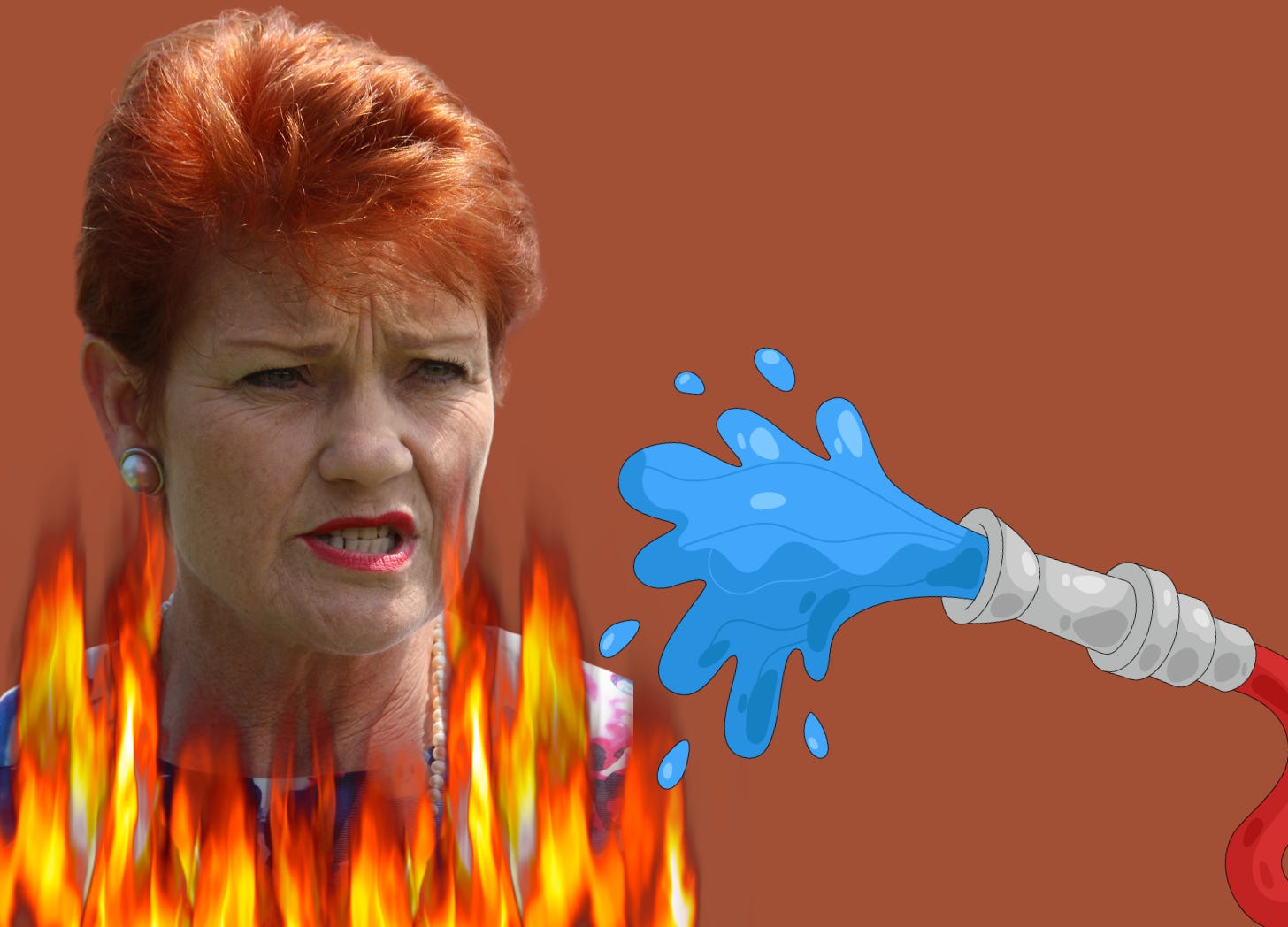
“We are always ready to believe what we fear.”—Mill, The British Constitution, 1826.
One Nation’s recent clinching of 3 (at most 4) in South Australia’s state Parliament of 69 has convinced some pundits that their hysteria over an inexorable lurch towards right-wing populism in Australia was well-founded. A reality check is in order. Not only is Pauline Hanson’s political vehicle destined to crash (at high speed), it is designed to.
In Australia, fringe political parties do not threaten our—more or less—centrist orthodoxy. To be sure, minor parties like One Nation influence lawmaking and their abhorrent nativism occupies disproportionate media space, but our unique method of election renders them transient irritations one bad showing away from expulsion to the political wilderness.
Preferential voting is our chief defence against populists and the discord they would wreak on society (save the odd crank who inevitably squeaks in, exceptio probat regulam). Unlike first-past-the-post (FPTP) in models, we have no wasted votes. The flow of preferred candidates pulls our politics towards moderation. We also elect members of parliament by seat, and the party occupying the highest number of seats in the House of Representatives wins the right to govern. This isn’t Presidential America. Additionally, governments are accountable to the electorate, who provide a thumbs up or thumbs down at each federal election. And for the duration of their term, party leadership works under the constant threat of a no-confidence vote on the floor of Parliament as well as intraparty spills (James Madison, Federalist 51, “Ambition must be made to counteract ambition”).
And yet for all these barriers inimical to Hansonism, media outlets point to opinion polls as evidence of a One Nation surge presaging a far-right future. The commentariat then goes on to speciously reason that statistical popularity translates to political viability. Prognostications phrased as questions like ‘what will happen if the election were held today?’, and ‘what is the two-party preferred?’ become highly profitable, as readers, junkie-like, crave their dopamine hit from the next issue and its attendant poll to either confirm or deny that day’s anxiety over Australia’s destiny.
There has been an undeniable rise in One Nation support in South Australia. But apart from that, and the myriad institutional barriers precluding Hanson’s party from evolving past vexation, we cannot forget that they did not run against their ideological competitor, the National Party of Australia. Indeed, One Nation’s pickups track with Liberal Party disillusionment. Their South Australian success rides in on the coat tails of popular discontent, Pauline Hanson’s ascendancy (for the moment) appears contingent on prevailing—localised—antipathy towards mainstream conservatism rather than a national mood. Being an island, xenophobia has been an essential feature of Australian politics. It premature to say whether this so-called ‘surge’ is attributed to the nation’s undulating bigotries. Popularity in politics, then, like in secondary school, can rise, fall, and flatline—observe Pauline Hanson’s career since the ‘90s, the modern LNP, or the short-lived federal ‘Greenslide’. Politics has never been linear.
Yet, all this being true, if our elections really are bulwarks against extremism, and if the opinion polls have been extrapolated into frivolity so that pundits can garner views, clicks, and subscriptions, why does One Nation and its matriarch even bother? Well, Pauline Hanson’s One Nation, being Pauline Hanson’s One Nation, is driven by self-interest and an urge to self-aggrandise instead of any serious concern for the well-being of everyday Australians. Hanson and her party live off a seemingly unlimited capacity to outdo themselves, daily hurdling those social norms that separate us from the animals. Because One Nation is an extension of Pauline Hanson, and because it abhors moderation, it will never be in a position to govern.
For example, Hanson is everywhere on One Nation’s website. Its “About Us” page reads more like ‘About Pauline’. Its online shop is stocked with merchandise stamped with Hanson’s likeness. There is a stubby cooler that reads ‘I have the guts to say what you’re thinking’ and an orange shirt declares the wearer’s allegiance, “I trust Pauline Hanson”. Hanson has even decided to tilt into MAGA rhetoric, with hats like “MAGA—Make Albo Go Away” and “Make Coal Great Again”. Interestingly, the LNP’s calamitous showing at the last federal election could in part be blamed on their flirtation with MAGA. Remember Jacinta Price’s decision to wear a MAGA hat? What about the LNP’s pivot from cost of living to culture wars like debates over Welcome to Country and Aboriginal and Torres Strait Islander flags? Scott Morrison experimented with the culture wars and Peter Dutton doubled down—look what happened to them. Culture wars clearly do not drive Australian politics. Therefore, Hanson’s active embrace of imported culture wars (identity politics, immigration, transgender athletes) after its repeatedly demonstrated inability to garner support from the broader Australian public has only two explanations: she is either unintelligent or she is uninterested in party politics. I favour the latter.
Ordinarily, political movements bundle together assorted values and objectives into a halfway considered philosophy. In One Nation’s case, there is no real direction, little cogency, and scant evidence of shared identity beyond rhetorical allegiance to Hanson and disdain of minorities (their uncritical and inordinate fear betrays them). Overall, One Nation is not aspiring to govern because it isn’t really a political party. It’s a tacky cult of personality.
Recapitulating, Pauline Hanson is a cultural danger. She is responsible for lowering political discourse to a lowest common denominator: diversity is bad. It is an irony lost on her sympathisers that her dream society is anathema to ‘Western’ notions of liberal democracy and individual rights. That said, Hanson genuinely believes what she says because she has been saying the same things for over 20 years, well before they were profitable. What worries people now is that her message appears to be sticking. But, thankfully, she isn’t a political operator. Compulsory preferential voting protects us from One Nation’s excesses. One Nation’s polling ‘surge’ is wrongly interpreted as a sign of an incoming far-right rapture. Hanson simply cannot overcome the iron laws of mathematics. And her preoccupation with culture wars indicates that she is not a serious politician: she merchandises her likeness online, effectively pines for WASP/Catholic Australia, and having been spotted fraternising with Australian billionaire Gina Rinehart, if following the money.
Civilised Australians should not read headlines and chew their nails in apprehension (“Is this what we’ve come to?”). As a senator, Pauline Hanson can’t even be Prime Minister. Pauline Hanson’s One Nation is just a brand name. Like Lacoste, Louis Vuitton, or Balenciaga, but closer to those tawdry designer knockoffs hawked to credulous tourists on the streets of Hong Kong. That, in fashion terms, is One Nation in a nutshell. Australia’s is not falling in because One Nation won a few seats in a South Australian state election.
Furthermore, monarchia delenda est.